Documentation
Customer Assets for JSM Portal gives your customers a secure self-service view of their assigned assets (JSM Assets / Insight) right inside the Jira Service Management customer portal. Customers browse and search their devices and licenses, edit schema-approved attributes and raise asset-linked requests: report a problem, register an asset, request a change or ask a question.
Requirements
- Jira Service Management Cloud with Assets (Premium/Enterprise).
- An asset schema where each object type has an owner reference attribute pointing at the Atlassian user who owns the object (the app auto-suggests likely candidates).
- A JSM project with request types the app can use for asset requests.
- Site-admin permissions for configuration.
cmdb.config.not.found. The built-in check ("Verify field" in step 1 of the configuration) detects exactly this case and tells you what to fix.
Setup in 4 steps
1 · Open the configuration
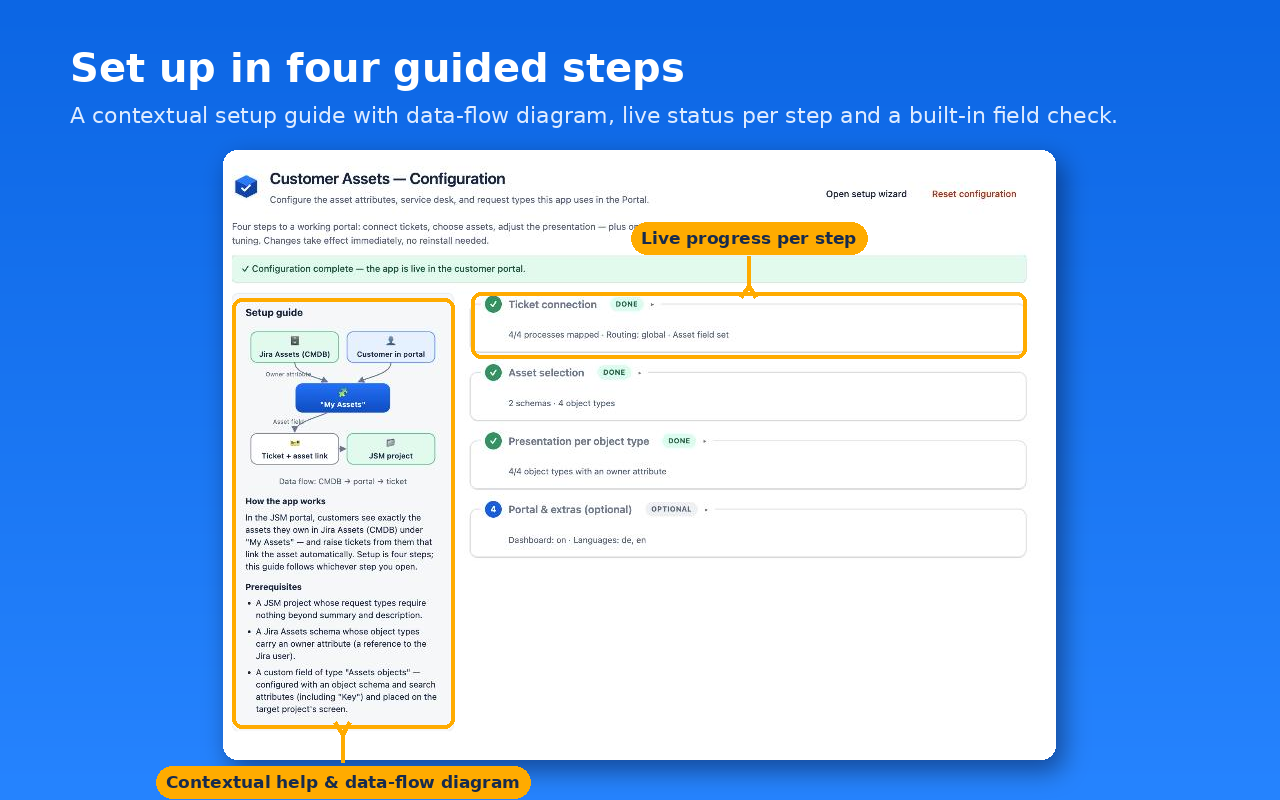
After installing, go to Jira administration → Apps → "Customer Assets — Configuration". On first run the setup wizard starts automatically; a contextual help panel with a data-flow diagram accompanies every step.
2 · Connect tickets
Pick your JSM service desk and the request types for asset issues and asset registrations, and select the Assets custom field used to link the affected asset. Then click "Verify field". It checks field existence, type, screen assignment and the Assets field configuration end to end.
3 · Connect assets
Choose your object schema and the object types customers should see. For each type, confirm the auto-suggested owner attribute. It scopes every query to the signed-in customer.
4 · Shape the experience
Per object type you set card attributes, a status attribute with color mapping, visible detail attributes, editability (direct vs. change-request) and icons. You can also add portal languages and translate object-type and attribute names. An optional dashboard start view (counters, status distribution, recent updates, quick actions) can be enabled globally.
How customers use it
Customers open "My Assets" from the customer portal user menu. They see only objects whose owner attribute matches their Atlassian account. The server enforces this, default-deny. From any asset they can report a problem, request a change or ask a question; each ticket automatically links the affected asset. Agents see the reporter's assets in the "Reporter Assets" glance in the issue view.
Security model
- Every resolver call resolves the customer scope from the signed Forge context and wraps every AQL query in a scope-binding predicate. No account ID → empty result set, even against a manipulated frontend.
- Updates are re-authorized server-side before writing.
- Admin endpoints verify Jira admin permissions as the calling user.
- No external endpoints: the app is eligible for the "Runs on Atlassian" badge. No data leaves your site. See the privacy policy.
FAQ
What if the "Verify field" check fails with a red result?
Follow the message shown for the failing check. It points at a wrong field type, a missing screen assignment in the target project, or an incomplete Assets field configuration. The last one is the most common cause of cmdb.config.not.found; see the yellow box above.
A customer sees no assets.
Check that the object type's owner attribute is set in the configuration and that the customer's Atlassian account is actually referenced in that attribute on their objects.
Which languages are supported?
The UI ships in English and German and follows each user's Atlassian profile language. Object-type and attribute names can be translated per site language in the configuration (step 3/4).
Does the app create Insight objects directly?
"Register asset" raises a ticket for your IT team by default, keeping data quality and audit trail in your hands. Per object type you can alternatively allow direct creation and editing by customers.
Support
Use the contact form. Please include your site URL (no credentials!), the app version and, for configuration issues, a screenshot of the "Verify field" result.